


Wireless charging is supposed to feel effortless. Yet in reality, many people still experience slow charging, overheating, or chargers that work well with one phone but poorly with another.
This confusion doesn't come from user error. It comes from the rapid evolution of wireless charging standards: Qi, MagSafe, Qi2, and now Qi2.2 — each solving different problems, but rarely explained in a way that helps everyday buyers make decisions.
To understand which wireless charger actually makes sense for you in 2026, it's important to understand why these standards exist and what problems they were designed to fix.
From Classic Qi to Magnetic Alignment: Why Wireless Charging Had to Change

Traditional Qi wireless charger charging relies on electromagnetic induction between two coils : one inside the charger and one inside your phone. When those coils are properly aligned, power transfers efficiently. When they are not, energy is lost as heat, and charging slows down dramatically.
This is why older Qi chargers often feel unreliable. Even a slight shift of your phone on the pad can reduce charging speed or interrupt charging altogether. Over time, manufacturers pushed Qi power levels higher, but without alignment control, higher wattage simply meant more heat and more inefficiency.
That limitation created the need for a new approach: not just higher power, but better positioning.
What MagSafe Actually Changed and What It Didn't
When Apple introduced MagSafe with the iPhone 12, the innovation was not wireless charging itself. It was controlled alignment.
MagSafe places a precisely positioned magnetic ring around the charging coil inside the iPhone. When paired with a MagSafe charger, the phone snaps into an optimal position automatically. This eliminates guesswork and ensures the coils remain aligned throughout the charging process.
As a result, MagSafe charging feels faster and more stable than older Qi chargers, even when the advertised wattage is similar. Heat is better managed, and charging interruptions are rare. However, MagSafe remains fundamentally an Apple-controlled ecosystem. Full charging speed depends on Apple certification, and non-Apple devices typically fall back to basic Qi behavior. This is why many users discover that a "MagSafe-compatible" charger does not necessarily deliver MagSafe-level performance on Android phones or even on iPhones without proper certification.
MagSafe solved alignment — but only inside Apple's walls.
Why Qi2 Exists: Making Magnetic Charging Universal

Qi2 is the wireless charging industry's answer to MagSafe's limitations. Developed by the Wireless Power Consortium, Qi2 takes the core idea that made MagSafe effective: magnetic alignment and turns it into an open, standardized system.
The most important technical feature of Qi2 is the Magnetic Power Profile (MPP). MPP defines how strong the magnets should be, where they should be placed relative to the charging coil, and how power negotiation should occur once alignment is achieved. This removes the guesswork that plagued older Qi chargers.
In practical terms, a Qi2 wireless charger does not simply deliver more power. It delivers power more consistently. When alignment is guaranteed, the charger can safely operate at up to 15W with lower thermal loss and fewer slowdowns caused by misplacement.
For consumers, Qi2 represents a shift from "wireless charging sometimes works" to "wireless charging works the way you expect it to."
Qi2.2: Why the Upgrade Matters More Than the Number Suggests

At first glance, Qi2.2 sounds like a minor revision. In reality, it reflects a deeper shift in how wireless charging is expected to perform.
Qi2 established reliable magnetic alignment at 15W. Qi2.2 builds on that foundation by allowing significantly higher wireless power: up to approximately 25W — while maintaining efficiency and thermal control. This is not simply about charging faster; it's about closing the gap between wired and wireless charging in everyday use.
With Qi2.2, wireless charging becomes viable not just for overnight charging or desk use, but also for short, high-impact charging sessions, the kind where you drop your phone on a charger for 20 minutes before heading out.
This is why a Qi2.2 charger is fundamentally different from older Qi or even Qi2 products. The standard assumes modern phone batteries, higher energy density, and user expectations shaped by fast wired charging.
Qi2.2 vs Qi2 vs MagSafe: Differences at a Glance
To make these differences concrete, the table below summarizes how the three standards compare in real-world terms:
|
Feature |
MagSafe |
Qi2 |
Qi2.2 |
|
Alignment method |
Apple proprietary magnetic ring |
Standardized magnetic alignment (MPP) |
Enhanced magnetic alignment |
|
Max typical wireless power |
Up to 25W |
Up to 15W |
Up to 25W |
|
Cross-brand compatibility |
Limited |
Broad, industry-wide |
Broad, next-gen |
|
Charging stability |
High (Apple devices) |
High (Qi2 devices) |
Very high |
|
Thermal efficiency |
Controlled by Apple |
Improved vs Qi |
Further optimized |
|
Future-proofing |
Apple ecosystem only |
Good |
Best |
Recommended INIU Wireless Charging Solutions
After understanding the similarities and differences between the wireless charging standards mentioned above, let's take a look at some of the most recommended INIU wireless charging products.
INIU P73-E1 Qi2 15W Wireless Power Bank
This Qi2-certified magnetic power bank combines 15W wireless charging with a 10,000mAh capacity and 45W wired output. In practice, this means you can rely on magnetic alignment for stable wireless charging while still having fast wired charging available when time matters.

INIU W31-E1 3 in 1 Wireless Charging Station
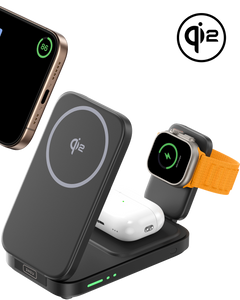
The INIU W31-E1 approaches Qi2 from a different angle. As a foldable 3-in-1 charger, it addresses a common modern problem: too many devices, too many cables. Qi2 magnetic alignment ensures your phone charges efficiently, while dedicated pads handle earbuds and a watch in a compact travel-friendly form. This product is ideal for users who own a full set of Apple devices.
INIU V11-E1 Qi2 Wireless Charger Mount
For drivers, the INIU V11-E1 applies Qi2 where alignment matters most: in motion. A magnetic car mount that charges at 15W without cable clutter solves both safety and convenience issues that plagued older Qi car chargers. The sturdy clamping arms and flexible mounting options make it the best choice for a car charger.

INIU P781 Qi2.2 25W Wireless Portable Charger (Coming Soon)
Looking ahead, the upcoming INIU P781 represents the transition to Qi2.2. By supporting higher wireless power output for compatible devices, it targets users who want genuinely fast wireless charging on the go, not just trickle charging. If you're using the latest iPhone 17 series phone, or want a wireless power bank that's future-proof for upcoming device updates, then this portable charger is definitely worth looking forward to.
FAQs
Q: Will a Qi2 charger work on my non-Qi2 phone?
A: Yes, as long as your phone support Qi wireless charging, but you might not get full magnetic speed. It will fall back to classic Qi speeds unless your device is Qi2-certified.
Q: Is Qi2.2 better than MagSafe?
A: Qi2.2 is the industry standard and supports faster speeds up to ~25W, whereas classic MagSafe is typically limited to around 15W (unless special higher-wattage models are used). Currently, Qi2.2 is the latest standard for wireless charging technology.
Q: Why do some Qi2 chargers not deliver full speed?
A: Real-world performance depends on your phone's support, case thickness, alignment, and thermal conditions — proper certification and magnetic alignment are key.
Final Thoughts
Wireless charging has spent years trading convenience for compromise, but that balance is finally shifting. MagSafe showed that alignment matters. Qi2 made magnetic wireless charging open and reliable across brands. And with Qi2.2, wireless charging is no longer just convenient — it is fast enough to handle real, everyday fast charging needs.
Once you understand that, wireless charging stops being confusing and starts doing exactly what it was meant to do.
