


Charging technology has evolved faster than ever in 2025, but what really matters to users? In an era where our professional and personal lives are inextricably linked to mobile silicon, "battery anxiety" has shifted from a search for any power outlet to a demand for high-speed, efficient, and intelligent energy delivery. We have officially moved past the era of simply "plugging things in." Today, the charging conversation revolves around thermal efficiency, magnetic precision, and the total liberation from cables.
The year 2025 has been defined by three technological pillars: the universal adoption of magnetic wireless standards, the shrinking size of high-wattage power bricks, and the rise of the high-capacity portable charger. This review breaks down the milestones of 2025 and previews the innovations that will power our lives in the coming half-decade.
What Were the Major Wireless Charging Trends in 2025?

How Fast Has Wireless Charging Evolved This Year?
In 2025, wireless charging finally shed its reputation for being "slow and hot." The long-standing debate of qi wireless charging vs magsafe reached a turning point as the industry consolidated around a unified magnetic alignment system.
Manufacturers have moved away from the "spray and pray" coil approach, where users had to manually find the "sweet spot" on a pad. Instead, the rise of the Active Alignment Coil, which uses micro-sensors to adjust the charging interface for maximum electromagnetic induction. We are now seeing that with Qi2.2 wireless charging technology, wireless charging speeds can consistently reach 25W, comparable to general wired charging speeds. Furthermore, real-world testing proves that modern magnetic systems reduce energy waste and heat by up to 30% compared to earlier standards.
What's the Difference Between Qi2 and Qi2.2?
The technical leap of the year was the transition from qi2 vs qi2.2. While Qi2 brought Apple's MagSafe-style magnetic snapping to the broader Android market in 2023, Qi2.2 (also known as Qi2 25W) refined the logic of power delivery.
Qi2: Established the 15W Magnetic Power Profile (MPP) as the universal standard. The Qi2 standard improves magnetic alignment and reduces power loss during wireless charging.
Qi2.2 (Qi2 25W): The 2025 "Speed & Thermal" update. It introduces Accessory Identification and improved thermal control, allowing chargers to safely push nearly 70% more power. It can now charge a smartphone from 0 to 50% in roughly 30 minutes wirelessly.
To date, the iPhone 17 series is the first mobile device to be compatible with Qi2.2 wireless charging. For anyone searching for the best wireless charger, checking for Qi2 or Qi2.2 certification is now the gold standard for future-proofing your tech arsenal.
How Are Fast Charging Power Banks Changing User Expectations?
The "brick" is dead; the "smart hub" is here. A modern fast charging power bank in 2025 is expected to do more than just charge a phone. High-density Graphene-Lithium hybrid cells and GaN-on-SiC (Silicon Carbide) technology allow 20,000 mAh units to fit in a pocket while delivering a staggering 140W PD 3.1 output.
Consumer pain points like "recharge time for the power bank itself" have been addressed; top-tier 2025 models can now be refilled at a faster speed, going from 0% to 100% in under 120 to 150 minutes. These units are now powerful enough to act as the primary power source for professional laptops (MacBook Pro, Dell XPS), effectively making traditional wall chargers redundant for weekend trips.

Are Users Still Confused About USB-C and GaN Charging?
Despite its prevalence, gan charging (Gallium Nitride) remains a top-searched technical term. In 2025, GaN + architectures have become the industry standard. These semiconductors replace traditional silicon, allowing chargers to be 30-40% smaller while maintaining a 95% energy efficiency rate.
Users questions have shifted from "What is GaN?" to "Can I use one 100W GaN charger for my portable wireless charger, my MacBook, and my Nintendo Switch simultaneously?" The answer in 2025 is a resounding yes, thanks to Dynamic Power Allocation, which intelligently negotiates the exact wattage needed for each port.

Why Do Consumers Still Compare Wireless Charging Options?

Qi Wireless Charging vs MagSafe – Which Should You Choose?
In 2025, the boundary between Qi Wireless Charging and MagSafe has largely vanished, thanks to the evolution of the Qi2 and Qi2.2 standard. While MagSafe originated as Apple's proprietary magnetic ecosystem, its core "Magnetic Power Profile" was contributed to the Wireless Power Consortium (WPC) to form the foundation of Qi2. For current users, this means that the high-speed 15W charging and perfect magnetic alignment features, previously exclusive to Apple products, will gradually become available on all devices.
By integrating advanced safety features and superior thermal management technology, many third-party charging brands like INIU have developed cost-effective and high-performance wireless chargers that can efficiently charge devices such as iPhones. Now, you no longer need to pay the exorbitant "Apple premium"; simply choose a powerful charger that can charge all your devices.
What Makes a Wireless Charger the "Best"?
The best wireless charger is no longer just about the highest wattage. According to 2025 consumer reports, top-tier chargers must feature:
Foreign Object Detection (FOD): Advanced sensors that prevent keys or coins from melting on the pad.
Quiet Cooling: Integrated silent fans or Peltier cooling plates that prevent thermal throttling during high-speed sessions.
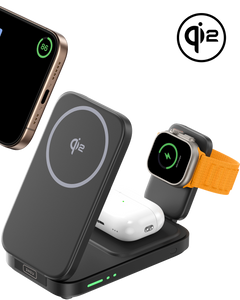
Versatility: 3-in-1 designs that can intelligently split power between a phone, a watch, and earbuds. In addition, for wireless power banks, supporting high-speed wired charging simultaneously is also a plus.
How Do Users Actually Experience Wireless Charging in Real Life?
Common complaints like "alignment issues" are being solved by N52 Neodymium magnets—the strongest used in consumer tech. These magnets ensure that even a heavy "Pro Max" or "Ultra" phone stays locked in place. Furthermore, some wireless charging models introduce the AI-driven power management, which learns your sleep patterns to slow down charging at night (reducing battery wear) and speeding it up right before your morning alarm.
How Are Charging Technologies Expanding Beyond Phones?

Can Portable Chargers Power Laptops?
The evolution of high output and high-capacity USB-C power banks has redefined what it means to stay productive on the move. No longer just a backup for your phone, a high-end power bank—like those pioneered by INIU—now serves as a legitimate portable wall outlet for your entire mobile office. Thanks to the universal adoption of USB-C Power Delivery (PD 3.0 and 3.1) technology, these units can output 65W, 100W, or even 140W, providing the sustained voltage required to power demanding laptops such as the MacBook Pro, Dell XPS, or high-end tablets like the iPad Pro at full speed.

Is USB to HDMI Still Relevant in a Wireless Era?
High-fidelity data still relies on physical connections for zero-latency tasks. The usb to hdmi cable remains a staple for the "Single Device Office." In 2025, many professionals use their smartphones as their primary computers. By connecting a usb c to hdmi cable from their phone to a monitor, they can access desktop environments like Samsung DeX or Apple's Stage Manager, all while the phone sits on a fast charging power bank to stay energized.

How Are Future Charging Innovations Addressing Consumer Pain Points?
The industry is moving toward "Ambient Charging." We are seeing the first commercially viable Radio Frequency (RF) charging, which can trickle-charge a device from across a room. Additionally, integrated furniture charging—where entire desks or nightstands act as a charging surface—is finally moving from luxury hotels into the average consumer's home, eliminating "cable clutter".
What Will Charging Look Like in the Next 5 Years?

Will Wireless Charging Become a Primary Power Source?
Wireless charging is expected to move beyond its role as a convenience feature and become a more reliable primary power option for everyday use. Improvements in magnetic alignment, power efficiency, and thermal management are enabling portable wireless chargers to deliver more consistent performance across a wider range of devices. Rather than being used only as backup solutions, wireless chargers are increasingly designed to support daily charging at home, in the office, and while traveling.
Will Wired Charging Still Be Necessary?
Despite advances in wireless power, wired charging will continue to play a critical role — particularly for high-power devices such as laptops and tablets. Compact GaN charging solutions are making it easier to deliver high output in smaller form factors, supporting multi-device setups with smarter power distribution. For users who rely on mobility, the evolution of the fast charging power bank category ensures that wired charging remains both practical and efficient when speed and capacity are essential.
Will One Charger Fit All Devices?
The vision for a universal charging standard is nearly a reality. With the USB-C PD protocol, we are moving toward a world where a single high power GaN charger can intelligently power everything from an electric toothbrush to a high-performance gaming laptop. This "one-charger-fits-all" philosophy is significantly reducing electronic waste globally.
What About Safety, Sustainability, and Regulations?
The next five years will see a "Green Charging" revolution. Regulatory bodies in the EU and US are now pushing for "Battery Passports," which track the carbon footprint and recycling path of the cells inside your portable wireless charger. Future AI-powered chargers will also participate in Bi-Directional Charging (V2G), allowing your EV or high-capacity power bank to feed energy back into your home during peak demand hours.
Conclusion
2025 marked an important transition year for consumer power technology. The long-standing distinction between traditional Qi wireless charging and Apple's MagSafe ecosystem began to narrow as Qi2 and Qi2.2 introduced standardized magnetic alignment and more efficient wireless power delivery across a wider range of devices.
Rather than focusing solely on peak wattage, the industry's priorities have shifted toward efficiency, thermal control, device compatibility, and intelligent power management. Whether through high-output GaN charging hubs for fixed setups or portable wireless chargers designed for travel and daily mobility, charging solutions are increasingly evaluated by how safely and consistently they deliver power — not just how fast they charge.
Wireless charging is no longer viewed purely as a convenience feature. As standards mature and performance continues to improve, it is becoming a practical component of modern workflows, complementing — and in some scenarios reducing reliance on — traditional cables. Looking ahead to 2026, the future of charging appears less fragmented, more standardized, and increasingly integrated into everyday device ecosystems.
