


Wireless chargers have brought new possibilities to charging people's devices, and with the continuous development of wireless charging technology, they have become a necessity for many people's lives. But if you've ever discover the best wireless charger, you've probably noticed how confusing the options are. What is Qi2 wireless charging means? Magnetic wireless charger stand or regular pad? Wireless charging stand, wireless car charger mount, or wireless power bank?
This guide breaks everything down by real-life usage scenarios, answering the same questions people repeatedly ask. Instead of focusing on specs alone, we'll look at how different wireless chargers actually fit into daily life, with practical examples using real INIU products.
What Is Qi2 Wireless Charging and Why Should You Care?

One of the biggest questions people ask today is whether Qi2 wireless charging really matters. Qi2 is the new mainstream wireless charging standard, developed to solve the most common complaints about older wireless chargers: slow charging, overheating, and poor alignment.
Why Qi2 Is Different
Qi2 introduces magnetic alignment as part of the standard. Instead of guessing where to place your phone on a charging pad, magnets guide the phone into the optimal charging position.
For users, this means:
- More consistent charging speeds
- Fewer failed overnight charges
- Better efficiency and less heat buildup
If you've used older wireless chargers, you might have been bothered by intermittent charging, but the Qi2 wireless charger greatly improves that.
Who Benefits Most from Qi2?
If you belong to any of the following groups, then purchasing a Qi2 wireless charger may bring you benefits:
- iPhone 12-17 series users who want MagSafe-like reliability
- Desk and bedside users who charge daily
- Anyone tired of repositioning their phone multiple times
Most of INIU wireless chargers are built around Qi2 wireless charging to provide stable 15W magnetic charging for everyday use.
Should I Get a Magnetic Wireless Charger or a Regular Wireless Pad?
This is one of the most common debates online—and the answer depends on how you use your phone while charging.
Regular Wireless Charging Pads
Wireless pads are simple: place your phone flat and let it charge.
They work well if:
- You charge mostly at night
- You don't interact with your phone while charging
- You want a minimal, low-profile setup
Wireless charging pads are ideal for users who prefer a clean desktop and don't need to use their phones while charging. The INIU W11-E1 is an excellent wireless charging pad, perfect for users with these kinds of needs.

Wireless Charging Stands
A wireless charging stand keeps your phone upright while charging, making it easier to use your device without interrupting power delivery.
They're a better choice if:
- You frequently pick up and put down your phone throughout the day
- You often check notifications, reply to messages, or take video calls while charging
- You want your screen visible without holding the phone
Compared with flat charging pads, charging stands are more practical for people who multitask on their phones.
For example, INIU W21-E1 is a Qi2 wireless iPhone charging stand designed for stable, hands-free charging. Its upright form factor allows you to comfortably watch videos, follow recipes, or use Face ID while charging, while Qi2 magnetic alignment helps ensure consistent charging performance. The clean design also makes it suitable for nightstands or workspaces without adding visual clutter. The detachable charging pad adds to its flexibility.
If you regularly interact with your phone while it's charging, a wireless charging stand is often more convenient and reliable than a flat wireless pad.

How Do I Choose a Wireless Charger for Travel & On-the-Go?

Wireless charging technology has evolved into portable devices, and wireless power banks can provide a wireless charging experience for people traveling or commuting.
Why Wireless Power Banks Are Different
A wireless power bank combines:
- A built-in battery
- Wireless (often magnetic) charging
- Portable, cable-free convenience
Instead of juggling a phone, cable, and power bank, you attach the charger and keep moving.
Real-World Use Case
- Commuting on public transport
- Airports and long travel days
- Conferences and events
INIU P73-E1 is a good example of this category. It combines a compact form factor with Qi2 magnetic wireless charging and enough capacity to support a full day of phone use. For people who value mobility, this style often becomes their daily charger.

What if I Need to Charge Multiple Devices at Once?
For Apple fans or users who use multiple Apple devices (iPhone, iPad, iWatch), a 3-in-1 wireless charging station can charge all their devices simultaneously. This greatly improves the charging efficiency of multiple devices. This is why 3 in 1 wireless chargers are so popular.
When a 3-in-1 Charger Makes Sense
- You use multiple APPLE devices daily
- Your nightstand or desk feels cluttered
- You want one charging routine instead of three
A 3 in 1 wireless charger replaces multiple cables with a single charging station.
INIU W31-E1 is designed as a foldable Qi2 magnetic 3-in-1 charger, supporting a phone, earbuds, and a iwatch charging area in one compact setup. This style is especially useful:
- On nightstands
- In small apartments
- For frequent travelers who want one charger for everything
Instead of charging speed alone, people who choose 3-in-1 chargers prioritize organization and convenience.
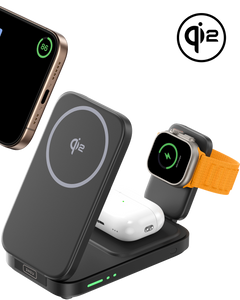
INIU SnapGo W31-E1 Qi2 15W 3 w 1 magnetyczna składana ładowarka bezprzewodowa
Is a Wireless Charger Car Mount Worth It?
Traditional USB car chargers require a charging cable to connect to a mobile phone, while wireless car charger holders offer new possibilities for in-car charging.
Why People Choose Wireless Car Chargers:
- Keeps phone visible for navigation
- Reduces cable wear
- Automatically charges when mounted
Magnetic alignment is especially valuable in cars, where vibration and movement can disrupt regular charging pads.
INIU V11-E1 is built for this scenario, combining Qi2 magnetic wireless charging with a secure car mount. For drivers who rely on navigation or ride-share apps, this setup provides stability and convenience without constant plugging and unplugging.
If you drive daily, a wireless car charger often becomes one of the most used chargers you own.

Should I Care About Qi2.2 and Future Proofing?

Qi2.2 is an incremental but meaningful upgrade over Qi2. While Qi2 focuses on magnetic alignment and stable 15W wireless charging, Qi2.2 is designed to support higher wireless power output, improved efficiency, and broader device support.
In practical terms, Qi2.2 aims to close the gap between wireless and wired charging by:
- Allowing higher wireless charging speeds on supported devices
- Improving power regulation to reduce energy loss and heat
- Expanding compatibility beyond early Qi2 adopters
Not every phone or accessory supports Qi2.2 yet, but the ecosystem is gradually moving in that direction.
Who Should Consider Qi2.2 Wireless Chargers?
You don't necessarily need Qi2.2 today—but it may be worth considering if you:
- Upgrade your phone in 1–2 years
- Plan to keep your charger for several device generations
- Want faster wireless charging as device support expands
For users who prefer buying once and using longer, Qi2 or Qi2.2 charger compatibility offers better future-proofing than older Qi-only models.
A Look Ahead: INIU P781 Qi2.2 Wireless Power Bank
INIU is preparing to introduce the P781 Qi2.2 wireless power bank, designed for users who want both portability and next-generation charging performance.
The P781 features:
- An ultra-slim design for easy everyday carry
- A digital display for real-time battery and charging status
- Up to 25W Qi2.2 wireless charging for compatible devices
- Up to 45W wired output, suitable for phones and other USB-C devices
For users who rely on wireless charging on the go and want higher power without sacrificing portability, Qi2.2 products like the P781 are positioned as a forward-looking option.
Comparison: Which INIU Wireless Charger Fits Your Lifestyle?
|
Lifestyle / Scenario |
Recommended INIU Model |
Why It Fits |
|
Minimalist nightstand |
INIU W11-E1 |
Qi2 magnetic stability, easy daily use |
|
Desktop stand |
INIU W21-E1 |
Convenient to use phone while charging |
|
Travel & commuting |
INIU P73-E1 |
Wireless power bank, cable-free mobility |
|
Multi-device charging |
INIU W31-E1 |
3 in 1 wireless charger convenience |
|
Driving & navigation |
INIU V11-E1 |
Secure wireless charger car charger |
|
Ultra-slim magnetic charging |
INIU P781-E1 |
Qi2.2 25W wireless charging for newest devices |
FAQ
Is wireless charging safe for my phone?
Yes. Certified wireless chargers follow strict power and temperature standards. Qi and Qi2 chargers regulate power automatically to protect battery health.
Does wireless charging damage battery health?
Not inherently. Heat is the main factor in battery wear, and newer standards like Qi2 improve efficiency and reduce unnecessary heat compared to older chargers.
Why does wireless charging feel slower than wired charging?
Wireless charging prioritizes convenience and consistency. While wired charging can be faster in some cases, Qi2 wireless charging delivers cable-free charging experience for overnight and daily use.
Do cases affect wireless charging?
Thick or metal cases can interfere. Magnetic wireless chargers perform better with compatible cases because alignment is more precise.
How does wireless charging actually work?
Wireless chargers use electromagnetic induction to transfer energy between coils in the charger and the phone—no physical connection required.
Conclusion
Choosing the best wireless charger isn't about chasing the highest watt number or the newest buzzword. It's about matching the charger to your daily habits. By understanding your real-world needs first, wireless charging becomes what it was always meant to be: simple, reliable, and invisible in daily life.
